Holidays on the Tyrrhenian Sea in Tuscany: a coastline of extraordinary variety between golden beaches, enchanting islands, nature reserves, historic villages and the great seaside tradition of the Tuscan coast.
The Tuscan Tyrrhenian Sea is one of the most complete and fascinating coastlines in Italy: it extends for over 600 kilometers from Versilia in the north to the Argentario and the Orbetello lagoons in the south, crossing natural, historical and cultural environments of extraordinary variety. The Tuscan coast is not a single homogeneous coastline but a sequence of territories with profoundly different characteristics: the worldly beaches of Versilia with Forte dei Marmi and Viareggio, the pine forests and nature reserves of the Maremma, the cliffs of the Etruscan Coast, the lagoons of Orbetello and the wild promontory of Argentario. Off the Tuscan coast is the Tuscan Archipelago, with seven islands — Elba, Giglio, Capraia, Giannutri, Pianosa, Montecristo and Gorgona — which form the largest marine park in Europe. Holidays on the Tyrrhenian Sea in Tuscany mean crystal clear sea, culture, gastronomy and nature in a balance that few other Mediterranean coasts can offer with the same depth and variety.
🌊 The Tuscan coast on the Tyrrhenian Sea: from Versilia to Maremma, a coastline for every type of traveler.
The Tuscan coast is divided into areas with very different characteristics, capable of satisfying every seaside holiday preference. Versilia, with the beaches of Forte dei Marmi, Marina di Pietrasanta and Viareggio, is the most worldly and well-equipped stretch, with bathing establishments of great tradition and a lively nightlife that animates the seafront on summer evenings. The Etruscan Coast, from Livorno to Piombino, alternates sandy beaches and cliffs with medieval villages in the hinterland and famous vineyards. The Tuscan Maremma, from Follonica to the Argentario, is the wildest and most natural stretch, with protected reserves, coastal dunes and lagoons that are home to a fauna of great variety. Each stretch of the Tuscan Tyrrhenian Sea has its own rhythm and an unmistakable landscape, making Tuscany a seaside destination capable of surprising even those who have been visiting it for years.
👉 What to do and useful tips: if it is the first time you visit the Tuscan coast on the Tyrrhenian Sea, divide your stay between at least two different areas — for example the Etruscan Coast for its sandy beaches and Etruscan villages and the Maremma for nature and the Argentario — so as to have a richer vision of the extraordinary variety that the Tuscan coast can offer in a few kilometers of coastline.
🏖️ The most beautiful beaches of Tyrrhenian Tuscany: sand, rocks and waters of the Tyrrhenian Sea between Versilia and Argentario.
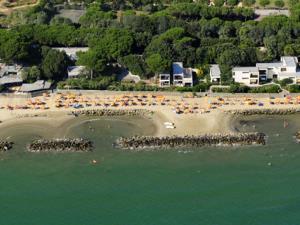
Tyrrhenian Tuscany boasts some of the most beautiful and varied beaches in Italy. In Versilia, the long beach of golden sand that stretches from Viareggio to Forte dei Marmi is well-equipped and frequented by a high-profile international audience. The Rocchette beach in the municipality of Castiglione della Pescaia is considered one of the most beautiful in the Maremma, with transparent waters and a pine forest behind it that offers natural shade. The Gulf of Baratti, on the Etruscan Coast, is one of the most evocative stretches of water in the Tyrrhenian Sea, nestled between the promontory of Populonia and the seabed rich in posidonia. The beaches of the Maremma Natural Park in Alberese are accessible only on foot or by bike and retain a rare naturalness. The Argentario promontory offers rocky coves that can only be reached by boat, with waters of a transparency that rival the islands of the Tuscan Archipelago.
👉 What to do and useful tips: reach the beaches of the Maremma Natural Park in Alberese by booking the entrance ticket in advance on the park's website, as the number of daily accesses is limited to protect the coastal ecosystem; the beaches of the park can be reached by shuttle or bicycle from the entrance station and represent among the most pristine stretches of coastline in all of Tuscany.
🏝️ The Tuscan Archipelago: the islands of the Tyrrhenian Sea in the largest marine park in Europe.
The Tuscan Archipelago National Park includes seven islands of very different beauty and character, all reachable by ferry from the ports of the Tuscan coast. The Island of Elba is the largest and most popular: with over 150 kilometers of coastline, pink granite beaches, historic villages such as Porto Azzurro and Marciana Marina and the Napoleonic remains of Portoferraio, it offers a variety of experiences that are difficult to match on an island in the Tyrrhenian Sea. The island of Giglio, reachable from Porto Santo Stefano, is a jewel of crystal clear waters and granite stone villages. Capraia, reachable from Livorno, is the wildest and most intact, with an extraordinarily rich seabed protected by the park's marine reserve. Pianosa, a former penal colony, is now partially open to visits with its virgin seabed and still flat roads to be traveled by bicycle.
👉 What to do and useful tips: book the ferry to the Island of Elba or Giglio at least one month in advance in July and August, when the rides sell out quickly; on Elba consider renting a sailboat or a dinghy to explore the less accessible coves of the northern coast of the island, where the waters reach shades of blue and green that few Mediterranean destinations can match.
🌿 The Tuscan Maremma: nature reserves, horses in the wild and the wildest coast of the Tyrrhenian Sea.
The Tuscan Maremma is the wildest and most fascinating stretch of the Tyrrhenian coast in the region: an area that includes the Maremma Natural Park, the Orbetello lagoons, the Argentario promontory and the nature reserves that follow one another along the Grosseto coast. The Maremma Natural Park, extended between Grosseto and Talamone, is one of the most important coastal parks in Italy, with Mediterranean scrub woods, coastal dunes, pine forests and a fauna that includes the famous Maremma horses in the wild and the Maremmana cattle breed. The Orbetello lagoon is a nesting and resting site for thousands of migratory birds, an ornithological heritage of European importance. The Argentario promontory, connected to the mainland by three thin strips of sand called 'tomboli', is a microcosm of nature and history with villages, Medici towers and a jagged coastline of great beauty.
👉 What to do and useful tips: explore the Maremma Natural Park with one of the guided horseback excursions organized by riding schools in the Alberese area; Riding through the Mediterranean scrub and the pine forest to the beaches of the park is one of the most evocative experiences that the Tuscan Maremma can offer, suitable for both experienced riders and beginners who approach horseback riding for the first time in a natural setting of great beauty.
🍽️ Tuscan seafood cuisine: cacciucco, fish from the Tyrrhenian Sea, bottarga and the flavors of the coast.
Tuscan seafood cuisine is a gastronomic tradition built around the resources of the Tyrrhenian Sea and the coastal lagoons, with dishes that tell centuries of maritime and fishing culture. Cacciucco alla livornese — a mixed fish soup with toasted bread rubbed with garlic, tomato and chilli pepper — is the best-known symbol of Tuscan seafood cuisine, prepared with five different qualities of rock fish and shellfish. The bottarga of Orbetello, made from the dried eggs of mullet caught in the lagoon, is one of the most sought-after gastronomic excellences of the Tyrrhenian Sea. Elba octopus, squid ink risotto, fried juveniles and Argentario shellfish complete a gastronomic repertoire of great personality. Vermentino della Costa Toscana IGT and Morellino di Scansano DOC accompany every meal with Mediterranean character.
👉 What to do and useful tips: taste the Orbetello bottarga in one of the restaurants in the historic center of Orbetello or in the local markets of Grosseto, where the artisanal product is found in its most genuine version; grated on pasta with Tuscan extra virgin olive oil and lemon zest, it is a preparation of a simplicity and depth of flavor that expresses the gastronomic identity of the Maremma lagoon better than any elaborate dish.
🏰 Historic villages and UNESCO World Heritage Sites on the Tuscan Tyrrhenian coast.
The Tuscan Tyrrhenian coast is not just sea: the coast is dotted with historic villages, Medici towers and cultural heritage of great importance that enrich every seaside stay with experiences of cultural depth. Pitigliano, in the inner Maremma, is an Etruscan village built on a tuff spur of extraordinary beauty, called the 'little Jerusalem' for its historic Jewish community. Porto Ercole and Porto Santo Stefano on the Argentario are charming seaside villages, with Spanish towers and alleys that descend towards the port. Populonia, on the Etruscan Coast, is the only Etruscan city directly overlooking the sea. Viareggio is famous all over the world for its Carnival and for the Art Nouveau architecture of its historic bathing establishments. The Val d'Orcia, a UNESCO World Heritage Site, reachable in less than an hour from the Maremma hinterland, completes a cultural itinerary of rare richness for a seaside destination.
👉 What to do and useful tips: plan a trip to Pitigliano during your holidays in Maremma, reaching the village at dawn to photograph the silhouette of the village emerging from the morning fog on the tuff spur; Combine a visit to the Etruscan Vie Cave in the surrounding area, deep corridors dug into the tuff by the Etruscan civilization that still cross the Maremma countryside like green and silent tunnels.
🚤 Water sports and marine activities on the Tuscan Tyrrhenian Sea: sailing, kitesurfing, snorkeling and diving.
The Tuscan Tyrrhenian Sea is a natural gym of great quality for those who practice water sports: the regular winds that sweep the coast, the moderate currents and the variety of the seabed offer optimal conditions for very different disciplines. Kitesurfing and windsurfing find their best conditions in the area of Follonica and Argentario, where the Tramontana and Libeccio winds guarantee high quality outings almost all year round. Sailing is at home on the entire Tuscan coast, with schools and well-equipped nautical centers from the marinas of Viareggio, Livorno, Punta Ala and Porto Santo Stefano. Snorkeling and scuba diving in the depths of the Tuscan Archipelago and the Giannutri Marine Reserve offer experiences of great naturalistic value with Mediterranean marine organisms of rare variety.
👉 What to do and useful tips: if you are passionate about scuba diving, contact the diving centers of Capraia or Giglio to organize trips to the seabed of the marine reserve of the Tuscan Archipelago National Park; the seabed around Giannutri and the shallows near Montecristo is considered among the richest and most intact in the Mediterranean and offers exceptional diving experiences for certified divers.
🌅 Versilia: Forte dei Marmi, Viareggio and the worldliness of the northern Tuscan Tyrrhenian Sea.
Versilia is the most famous and popular stretch of the Tuscan Tyrrhenian coast: a coastal strip of a few kilometers that has built over time a reputation for elegance, worldliness and quality of hospitality recognized internationally. Forte dei Marmi is the most exclusive destination, frequented by Italian upper-middle-class families and foreign visitors attracted by the beauty of the beach, the quality of the restaurants and the discreet and refined atmosphere that characterizes the town. Viareggio is more popular and lively, with a wide and lively promenade, historic Art Nouveau bathing establishments, fish restaurants of the highest level and the Viareggio Carnival that attracts hundreds of thousands of visitors from all over Italy every February. Marina di Pietrasanta and Lido di Camaiore complete a Versilia offer capable of satisfying every type of visitor, from the most demanding to the simplest in demands.
👉 What to do and useful tips: visit the historic center of Pietrasanta, a few kilometers inland from the Versilia coast, to discover the marble and bronze sculpture workshops that have made this village famous in the world of contemporary art; Many international artists have workshops and foundries in this small town, which hosts exhibitions and cultural events throughout the summer season in a medieval setting of great beauty.
🗺️ How to reach the Tuscan Tyrrhenian coast and organize your stay by the sea.
The Tuscan Tyrrhenian coast is easily accessible from all over Italy and Europe. The main airports of reference are those of Pisa Galileo Galilei, well connected with European and national destinations, and Florence Peretola, closer to Versilia and the Florentine area. Grosseto Baccarini Airport is the most convenient access point to the Maremma and the Argentario. By train, the Tyrrhenian railway line connects all the main centers of the Tuscan coast from Viareggio to Orbetello-Monte Argentario, with stations in Livorno, Cecina, San Vincenzo, Follonica, Grosseto and beyond. By car, the A12 motorway reaches Versilia and Livorno, while the Via Aurelia SS1 runs along the entire coast up to the Lazio border. Ferries to the Tuscan Archipelago depart from the ports of Livorno, Piombino, Porto Santo Stefano and Portovecchio.
👉 What to do and useful tips: if you intend to visit both the Tuscan coast and one of the islands of the Tuscan Archipelago during the same holidays, choose as a base a structure near the ports of embarkation of Piombino for Elba or Porto Santo Stefano for Giglio; The proximity to the port will allow you to take the morning ferry, spend a whole day on the island and return in the evening without having to deal with long transfers that eat up precious hours of vacation.
❓ F.A.Q. - Frequently asked questions about holidays on the Tyrrhenian Sea in Tuscany.
🗓️ When is the best time to holiday on the Tyrrhenian Sea in Tuscany?
June and September are the most recommended periods: the sea is warm, the beaches less crowded than in July and August and the temperatures pleasant even in the evening hours. July and August are the peak season with maximum entertainment along the entire Tuscan coast, but require very early bookings. Versilia and Argentario are in high demand and sell out quickly in high season.
🏝️ Which island of the Tuscan Archipelago is recommended for a first visit?
The Island of Elba is the most complete choice for those visiting the Tuscan Archipelago for the first time: it offers a wide variety of beaches, historic villages, hiking trails, wine cellars and tourist services of all levels. Giglio is perfect for those looking for crystal clear waters and a more intimate atmosphere. Capraia is ideal for lovers of unspoiled nature and scuba diving.
🍽️ What is Orbetello bottarga and where can it be purchased?
Orbetello bottarga is a gastronomic product of great value obtained from the dried eggs of mullet caught in the Orbetello lagoon. It is available in the fishmongers and shops selling typical products in the historic center of Orbetello and in the gastronomic shops of Porto Santo Stefano and Porto Ercole. It can be purchased whole, in slices or already grated, and can be kept for a long time if stored in a cool, dry place.
🌿 Does the Maremma Natural Park require a reservation for entry?
Yes, the Maremma Natural Park in Alberese requires advance booking of admission, especially in the summer months, as the number of daily visitors is limited to preserve the coastal ecosystem. Reservations can be made online on the park's website or at local information points. Some guided hikes and horseback riding trails also require advance reservations.
⛵ How do you reach the Island of Elba from the Tuscan coast?
The Island of Elba can be reached by ferry from the port of Piombino, with crossings lasting about an hour for traditional ferries and 30 minutes for fast hydrofoils. Car-passenger ferries depart several times a day throughout the season, with maximum frequency in July and August. In summer it is strongly advisable to book the ferry in advance, especially if you are traveling by car.
🏰 Can Pitigliano be reached from the Maremma coast in a day?
Yes, Pitigliano can be easily reached from the Maremma coast in about 40-50 minutes by car from the Argentario or Grosseto. It is a half-day trip that allows you to visit the Etruscan historic center, the vie cave in the surroundings and the museum of Jewish culture, returning in time for the afternoon to the beach. Combining Pitigliano with Sovana and Sorano, in the immediate vicinity, allows you to create a cultural itinerary of great value.
🚤 Is kitesurfing practiced on the Tuscan Tyrrhenian Sea?
Yes, kitesurfing is widely practiced along the Tuscan coast, with some spots of excellence in the Follonica area, in the Orbetello lagoon and on the beaches exposed to the prevailing winds of the Argentario. Kitesurfing and windsurfing schools are present in the main seaside resorts and offer courses for beginners and equipment rental for the more experienced. The best times for practice are spring and autumn, when the winds are more regular and intense.
🌊 Are the beaches of Versilia suitable for children?
Yes, the beaches of Versilia are generally suitable for children thanks to the sandy and shallow seabed that slowly slopes offshore. The bathing establishments are well equipped with services for families, high chairs, play areas and lifeguards. Forte dei Marmi and Marina di Pietrasanta offer beaches with particularly calm waters and high-level services for families.
🍷 Which typical wines go well with Tuscan seafood cuisine?
Vermentino della Costa Toscana IGT is the most suitable white for fish dishes from the Tuscan Tyrrhenian Sea, fresh and savory with marine notes that enhance the flavor of the catch. Ansonica dell'Isola d'Elba DOC is a typical white wine of the archipelago. Morellino di Scansano DOC, on the other hand, accompanies the meat and game dishes of the Maremma with the typical structure of Sangiovese grown in the coastal area.
📅 How far in advance should I book for holidays on the Tuscan Tyrrhenian Sea?
For July and August it is strongly advisable to book at least three or four months in advance, especially for the most popular destinations such as Forte dei Marmi, Argentario, Castiglione della Pescaia and the islands of the archipelago. The most popular facilities sell out quickly. For June and September, availability is found two months in advance, often at significantly cheaper rates than at the summer peak.
The Tuscan Tyrrhenian Sea is a seaside destination that never ceases to surprise: each stretch of the coastline tells a different story, from the discreet glamour of Versilia to the unspoiled nature of the Maremma, from the emerald waters of the Tuscan Archipelago to the cliffs of the Etruscan Coast, from the scents of the Mediterranean scrub in the Argentario to the Etruscan villages in the Grosseto hinterland. Holidays on the Tyrrhenian Sea in Tuscany offer something that few Mediterranean coasts can guarantee with the same naturalness: the sea as a starting point for a total experience of the territory, where the beach is only the beginning of a discovery that continues among the Supertuscans' cellars, the paths of the Maremma Park, the white roads of Chianti and the medieval villages that can be glimpsed from the shore on clear days. Youritaly.it collects useful information for those who want to better plan their holidays on the Tyrrhenian Sea in Tuscany, orienting themselves among the beaches, the islands of the Tuscan Archipelago, the nature reserves, the historic villages and the great gastronomic tradition of a region that has made beauty its deepest vocation.